How margin pricing is calculated
Learn how a SKU's selling price is built from cost, margin and tax, and how assembled units and cost-price quotations are handled.
A SKU's selling price is computed as unit_price ÷ (1 − margin/100) × (1 + tax/100). Margin is treated as a fraction of the FINAL selling price, not a markup on cost: 20% margin on a 100 base gives 125 (100/0.8), not 120 — the most common 'price is higher than cost plus margin' confusion. Tax multiplies the margined amount. Percentage SKU discounts are then computed on this margined, taxed amount; absolute SKU discounts are per display-unit and scale with area/length/count. Two additional margin layers exist for assembled units: cabinets and corner units carry a saved cumulative_margin that multiplies the entire assembled price (and its SKU discount) by 1/(1 − cm%); and if a cabinet's price row has override_margin enabled, the cabinet's own margin AND tax replace every constituent's margin/tax — including conversion, assembly and packaging cost uplifts — so constituents sell at the cabinet's margin regardless of their own settings. Cost-price quotations are produced by recomputing with margin set to 0 (and tax 0 where applicable), not by subtracting a stored margin amount, so cost price can differ from a naive 'price minus margin%' calculation.
To price an item at double its cost, the margin to enter is 50%.
✓ ২০ অক্টোবৰ, ২০২৬ তাৰিখে প্ৰডাক্টত পৰীক্ষা কৰা হৈছে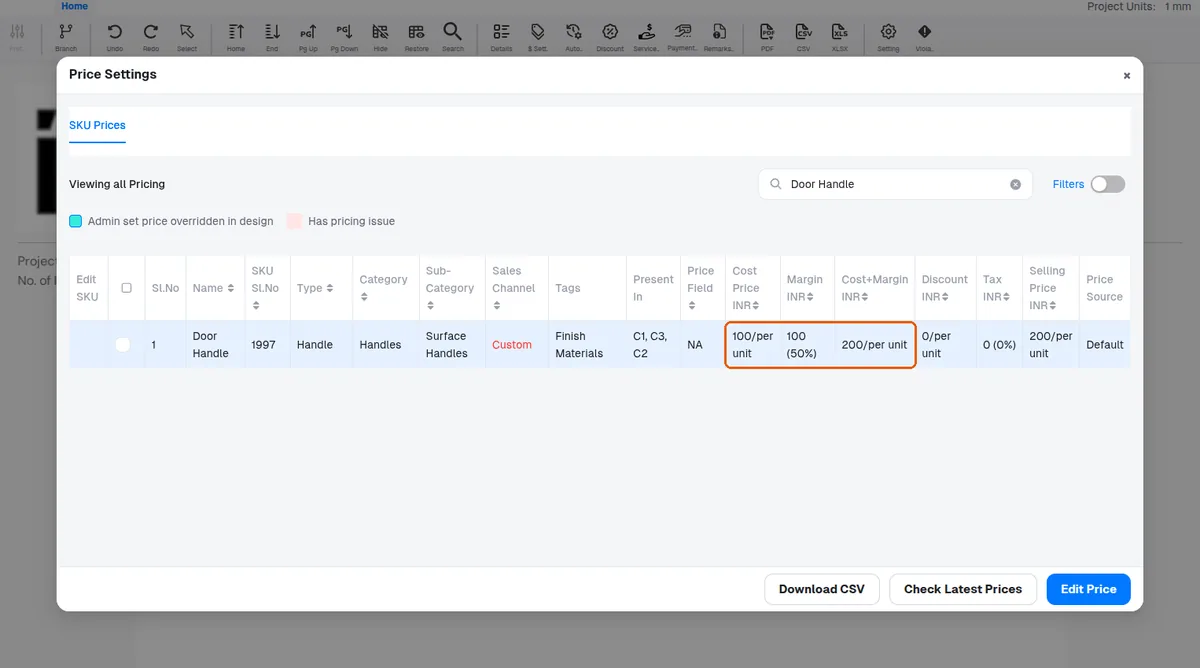
margin = (1 − cost price ÷ selling price) × 100, the inverse of the selling-price formula.
There is no separate markup option — margin is always a share of the selling price.
Transportation and installation charges — including those computed on frontal area — can be included in the calculation so they are folded into the final client-facing total.